Table of Contents
- Why Make Hair Masks at Home?
- How Masks Work in Three Simple Science Points
- What to Check Before You Start
- Core Ingredient Categories and Expected Results
- Recipe Library with Variations for Common Goals
- How to Mix, Apply, and Rinse for Best Results
- Timing Guide and Frequency by Hair Type
- Adapting Masks for Colored or Chemically Treated Hair
- Safety, Allergy Testing, and Common Contraindications
- Troubleshooting: Residue, Weigh Down, or Brittle Feel
- Building a Routine: Weekly and Monthly Templates
- Quick Experiments to Tailor a Recipe to Your Hair
- Sources and Further Reading
Why Make Hair Masks at Home?
Creating a DIY hair mask is more than just a fun, budget-friendly activity; it’s about taking control of what you put on your hair and scalp. Commercial products can be fantastic, but they often contain preservatives, synthetic fragrances, and complex chemical lists that might not be right for everyone. When you make a hair mask at home, you get to choose fresh, natural ingredients tailored specifically to your hair’s needs. You can address dryness, damage, or dullness with simple, potent ingredients straight from your kitchen. This hands-on approach empowers you to understand your hair better and nourish it from the outside in, without any hidden extras.
How Masks Work in Three Simple Science Points
Ever wonder what’s happening when that creamy concoction sits on your head? A DIY hair mask isn’t magic; it’s simple science at work. Here’s a breakdown of the three key actions:
- Adsorption and Absorption: Your hair has a complex structure. Ingredients like oils and proteins don’t just sit on top; they adsorb (stick to the surface) and, in some cases, can be small enough to absorb (penetrate) the outer layer, called the cuticle. This process fills in microscopic gaps caused by damage, making hair feel smoother.
- Cuticle Sealing: The hair cuticle is made of overlapping scales. When hair is damaged or has a high pH, these scales lift, causing frizz and moisture loss. Acidic ingredients like yogurt or a diluted apple cider vinegar rinse help lower the hair’s pH, encouraging the cuticles to lie flat. This seals the hair shaft, locking in moisture and creating a shinier, smoother appearance.
- Hydration and Emollience: Many DIY hair mask ingredients are rich in water, humectants (which attract water), and emollients (like oils and fats). Humectants pull moisture into the hair, while emollients create a protective barrier to prevent that moisture from escaping. This dual-action effect is what leaves your hair feeling soft and moisturized long after you rinse.
What to Check Before You Start (Hair Porosity, Scalp, Allergies)
Before you start mixing, a quick check-up on your hair and scalp will help you choose the best ingredients for your DIY hair mask. This step ensures you get great results and avoid potential irritation.
- Hair Porosity: This refers to your hair’s ability to absorb and retain moisture. It’s a game-changer for choosing ingredients.
- Low Porosity: Cuticles are tightly packed. Hair takes a long time to get wet and to dry. It’s prone to product buildup. You’ll need lightweight ingredients like argan oil, aloe vera, and glycerin that won’t just sit on top.
- Medium Porosity: The “sweet spot.” Hair absorbs and retains moisture well. It benefits from a balance of proteins and moisture.
- High Porosity: Cuticles are raised or have gaps. Hair absorbs moisture quickly but loses it just as fast. It often feels dry or frizzy and can be prone to damage. It craves heavier oils, butters, and proteins to fill gaps and seal in moisture.
A simple (though not perfectly scientific) test is to place a clean, dry strand of hair in a glass of water. If it floats, you likely have low porosity. If it sinks slowly, you have medium porosity. If it sinks quickly, you have high porosity.
- Scalp Condition: Is your scalp oily, dry, flaky, or sensitive? An oily scalp won’t appreciate a heavy oil treatment at the roots, while a dry scalp will love it. For sensitivity, soothing ingredients like oatmeal or chamomile are excellent choices.
- Allergies: Always perform a patch test. Before applying a full DIY hair mask, dab a small amount of the mixture on your inner elbow or behind your ear. Wait 24 hours to see if any redness, itching, or irritation occurs. This is crucial if you have known allergies to foods like nuts, dairy, or eggs.
Core Ingredient Categories and Expected Results
Understanding the “why” behind each ingredient will help you become a DIY hair mask pro. Most ingredients fall into one of three functional categories.
Oils: When to Use Them and Which Ones Suit Which Hair
Oils are fantastic emollients that seal in moisture, add shine, and reduce friction between strands. However, not all oils are created equal. Their molecular structure determines whether they penetrate the hair shaft or coat it.
- Penetrating Oils: These have smaller molecules that can get inside the hair shaft to moisturize from within. Best for dry, damaged, and high-porosity hair. Examples include coconut oil, babassu oil, and olive oil.
- Sealing Oils: These have larger molecules that coat the outside of the hair, sealing the cuticle and preventing moisture loss. Ideal for low-porosity hair or as a final step for high-porosity hair. Examples include jojoba oil, argan oil, and grapeseed oil.
- Scalp-Balancing Oils: Some oils, like jojoba oil, closely mimic the scalp’s natural sebum and can help balance oil production. Tea tree oil (used very sparingly and diluted) has antimicrobial properties beneficial for dandruff.
Proteins and Binders: Repair Without Stiffness
Hair is primarily made of a protein called keratin. When hair is damaged, it loses protein, creating weak spots. A protein-based DIY hair mask can temporarily patch these spots, adding strength and structure.
- Common Sources: Egg (the yolk for fats and nutrients, the white for protein), plain yogurt or Greek yogurt (lactic acid and protein), and gelatin.
- Vegan Alternatives: Aquafaba (the liquid from a can of chickpeas) or pureed tofu can provide a similar strengthening effect.
- The Caution: Too much protein can lead to “protein overload,” making hair feel stiff, dry, and brittle. If your hair feels like this, switch to a purely moisturizing mask for a few weeks. Fine hair often loves protein, while coarse, dry hair may need it less frequently.
Humectants and Acids: Hydration and pH Balance
Humectants are ingredients that attract water from the atmosphere and bind it to the hair, providing deep hydration. Acids help with the pH balance of your scalp and hair.
- Humectants: Honey is a natural humectant and has antimicrobial properties. Aloe vera gel is incredibly hydrating and soothing for the scalp. Glycerin is a powerful humectant but can be sticky, so use it sparingly.
- Acids: A healthy hair and scalp pH is slightly acidic (around 4.5-5.5). Using ingredients like plain yogurt (lactic acid) or a very diluted apple cider vinegar rinse helps lower pH, which flattens the cuticle for enhanced shine and smoothness.
Recipe Library with Variations for Common Goals
Here are five foundational DIY hair mask recipes. Remember to blend all ingredients until completely smooth to avoid chunks in your hair!
Hydration Boost: Avocado and Honey with Oil Swap Options
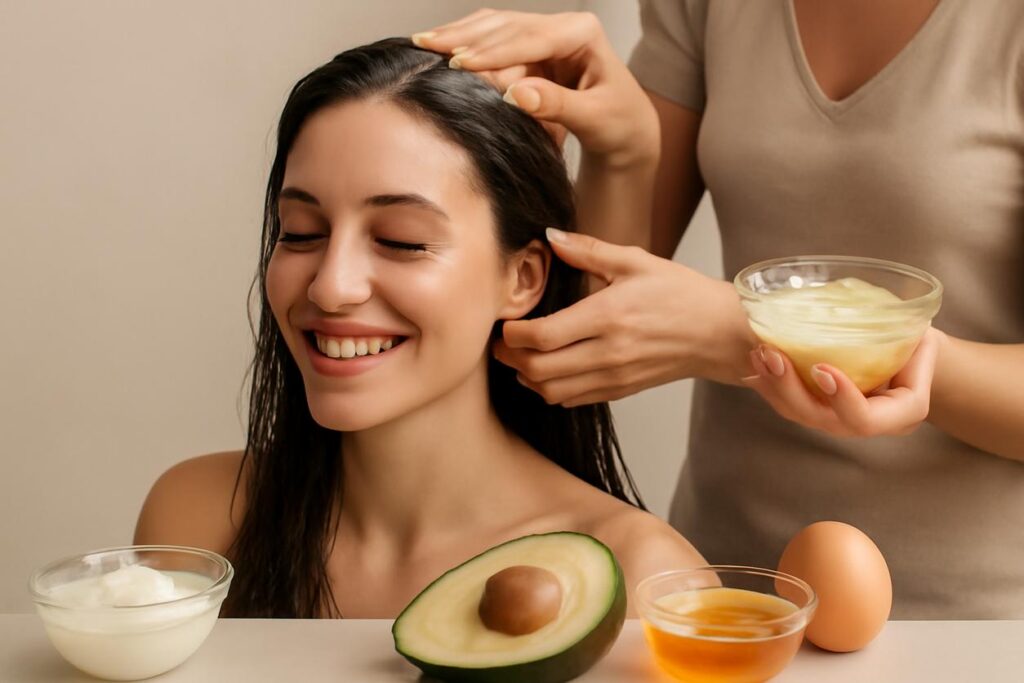
Perfect for dry, dull, or thirsty hair, this mask is packed with healthy fats, vitamins, and humectants.
- Ingredients: 1/2 ripe avocado, 1 tablespoon honey, 1 tablespoon oil.
- Instructions: Mash or blend the avocado until perfectly smooth. Mix in the honey and your chosen oil.
- Oil Swaps:
- For deep moisture: Use olive oil or coconut oil.
- For normal/fine hair: Use argan oil or jojoba oil.
Repair and Strength: Yogurt and Egg with Vegan Alternatives
Ideal for damaged, weak, or over-processed hair that needs a structural boost.
- Ingredients: 1 egg, 2-3 tablespoons plain full-fat yogurt.
- Instructions: Whisk the egg thoroughly, then stir in the yogurt until combined.
- Vegan Alternatives:
- Replace egg and yogurt with 1/4 cup blended silken tofu and 1 tablespoon maple syrup (for its humectant properties).
Lightweight Refresh for Fine Hair: Aloe and Coconut Water Formulas
This mask provides hydration without weighing down fine or easily greased hair.
- Ingredients: 2 tablespoons pure aloe vera gel, 2 tablespoons coconut water, 1 teaspoon jojoba oil.
- Instructions: Whisk all ingredients together until you have a uniform, liquid consistency. This is best applied with a spray bottle or by carefully pouring over sections of hair.
Curl Definition and Moisture: Banana and Olive Oil Method
Bananas are rich in silica, which can help improve hair texture, while the oil provides deep moisture essential for curls.
- Ingredients: 1 ripe banana, 1 tablespoon olive oil, 1 teaspoon honey (optional).
- Instructions: Blend the banana until it is completely pureed. This step is critical to avoid banana chunks. Stir in the olive oil and honey.
Sensitive Scalp Calm: Oat and Chamomile Infusion
This soothing mask is perfect for an itchy, irritated, or dry scalp.
- Ingredients: 1/4 cup rolled oats, 1/2 cup hot water, 1 chamomile tea bag.
- Instructions: Steep the chamomile tea bag in the hot water for 10 minutes. While it steeps, blend the oats into a fine powder. Remove the tea bag and slowly add the warm tea to the oat powder, stirring until a smooth paste forms. Let it cool to a comfortable temperature before applying.
How to Mix, Apply, and Rinse for Best Results
Application technique makes a huge difference in the effectiveness of your DIY hair mask.
- Preparation: Always start with clean, damp hair. Shampoo your hair first to remove product buildup, which allows the mask to penetrate better. Gently towel-dry until it’s not dripping wet.
- Mixing: Use a blender for ingredients like avocado, banana, or oats to ensure a completely smooth consistency. Lumps are difficult to rinse out.
- Application: Section your hair and apply the mask from roots to ends, focusing on the mid-lengths and ends where hair is oldest and most damaged. If you have an oily scalp, apply the mask from the mid-lengths down. Use a wide-tooth comb to gently distribute the product.
- Processing: Pile your hair on top of your head and cover it with a shower cap or plastic wrap. This traps heat, which helps open the hair cuticle for better absorption.
- Rinsing: Rinse thoroughly with lukewarm water. Hot water can strip moisture, while cold water may not effectively remove oils. Rinse until your hair feels clean and free of residue. You may follow up with a light conditioner to seal the cuticle, but it’s often not necessary.
Timing Guide and Frequency by Hair Type
How long you leave a mask on and how often you use one depends on your hair’s condition.
| Hair Type | Duration | Frequency |
|---|---|---|
| Fine or Oily Hair | 15-20 minutes | Every 2 weeks |
| Normal / Medium Hair | 20-30 minutes | Once a week |
| Dry or Coarse Hair | 30-45 minutes | 1-2 times per week |
| Damaged or High Porosity Hair | 30-60 minutes (or longer) | 1-2 times per week |
Adapting Masks for Colored or Chemically Treated Hair
Chemically treated hair has a compromised cuticle, making it highly porous and prone to color fading. When making a DIY hair mask for treated hair, focus on two things: intense moisture and pH balance.
- Favor deeply hydrating ingredients like avocado, banana, and penetrating oils.
- Always include a mildly acidic ingredient like yogurt or a few drops of apple cider vinegar in your mixture to help seal the cuticle, which protects the color.
- Avoid highly acidic masks (like those heavy on lemon juice) or staining ingredients (like some spices) that could alter your hair color.
Safety, Allergy Testing, and Common Contraindications
Natural doesn’t always mean non-reactive. Your skin and scalp can be sensitive to ingredients you eat without issue.
- Always perform a patch test 24 hours before a full application, especially when using a new ingredient.
- Be mindful of common food allergens like eggs, dairy, nuts (in oils), and gluten (in oats).
- Never use ingredients that are spoiled or rancid. Fresh is best for your DIY hair mask.
- If you have a scalp condition like psoriasis or eczema, consult a dermatologist before applying homemade treatments.
Troubleshooting: Residue, Weigh Down, or Brittle Feel
Didn’t get the results you hoped for? Don’t give up! A small tweak can make all the difference.
- Hair Feels Greasy or Weighed Down: You may have used an oil that was too heavy, used too much product, or didn’t rinse thoroughly enough. Try using a lighter oil (like jojoba), apply only to the ends, or do a final rinse with diluted apple cider vinegar to cut through the residue.
- Hair Feels Gritty or Has Residue: Your mask wasn’t blended smoothly enough. A blender is your best friend for ingredients like banana and oatmeal.
- Hair Feels Stiff or Brittle: This is a classic sign of protein overload. Your hair has enough protein and needs moisture. Skip the egg and yogurt for a few weeks and stick to hydrating masks with ingredients like avocado, honey, and aloe vera.
Building a Routine: Weekly and Monthly Templates
Consistency is key to seeing long-term benefits from any hair treatment. Integrating a DIY hair mask into your routine can be simple. Consider this a core part of your 2025 hair care strategy for healthier, more resilient hair.
- Weekly Template (for most hair types):
- Day 1: Clarifying Shampoo (if you use lots of products) followed by a moisturizing DIY hair mask (e.g., Avocado and Honey).
- Day 4: Co-wash or gentle shampoo and regular conditioner.
- Monthly Template (integrating protein):
- Week 1: Moisturizing Mask.
- Week 2: Regular wash day.
- Week 3: Strengthening/Protein Mask (e.g., Yogurt and Egg).
- Week 4: Regular wash day.
Listen to your hair. If it feels dry, add moisture. If it feels limp and overly soft, it might be asking for a protein treatment.
Quick Experiments to Tailor a Recipe to Your Hair
The best DIY hair mask is the one you customize perfectly for yourself. Start with a base recipe you like and try these small additions one at a time to see how your hair reacts:
- For extra shine: Add a teaspoon of diluted apple cider vinegar to your final rinse.
- For scalp health: Add 1-2 drops of tea tree or peppermint essential oil (mixed into a carrier oil first, never directly).
- For a moisture boost: Add a teaspoon of vegetable glycerin to any hydrating mask.
- To fight frizz: Swap a tablespoon of your base liquid for pureed cucumber for its silica and hydrating properties.
Sources and Further Reading
Doing your own research is a great way to deepen your understanding of hair science and nutrition. These resources provide evidence-based information on health and wellness.
- PubMed: A database of biomedical literature for in-depth scientific studies on hair and dermatology.
- NHS Hair and Scalp Care: Practical, trustworthy advice on general hair health from the UK’s National Health Service.
- Eat for Health: An overview of nutrition basics, because healthy hair starts from within.
- Harvard Health Publishing: Provides accessible health information, including articles on the benefits of natural oils for skin and hair.